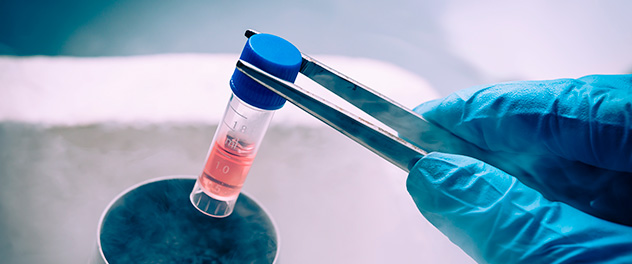
 Fighting cancer with stem cells
The Brain Tumor Stem Cell Research Lab converts human fat cells into cancer-fighting Trojan horses and delivers the cells to patients in a gel during brain cancer surgery.
Local administration of stem cells from fat during brain surgery using a gel
The Brain Tumor Stem Cell Research Lab at Mayo Clinic is evaluating the efficacy of commercial fibrin sealant as a scaffold to hold fat-derived human mesenchymal stem cells within the brain cancer resection cavity during surgery. This will make it possible to locally apply bioengineered, tumor-attacking human mesenchymal stem cells to tumor cells that may remain inside the resection cavity during surgery.
Dr. Quinones-Hinojosa's lab has successfully bioengineered mesenchymal stem cells derived from human fat to attack brain tumor initiating cells, a specialized subset of glioblastoma cells. However, there is still a need to deliver human mesenchymal stem cells efficiently into the brain tumor resection cavity during surgery to kill residual tumor cells.
A two-component fibrin sealant has been approved by the U.S. Food and Drug Administration and is used widely in surgical procedures. It has been previously shown to efficiently hold bone marrow-derived mesenchymal stem cells for local therapy of glioblastoma in a mouse model. However, Dr. Quinones-Hinojosa's team is using human fat-derived mesenchymal stem cells that are bioengineered to secrete bone morphogenetic protein 4 (BMP4) and are more readily available. The team also is evaluating the cells' various functions, such as viability and proliferation within a fibrin scaffold.
The team's goal is to be able to deliver bioengineered, tumor-killing fat-derived mesenchymal stem cells locally into the resection cavity of patients with glioblastoma during surgery, ultimately significantly prolonging the patients' lives.
Project team
Lab members developing a gel to locally apply mesenchymal stem cells during brain surgery include:
- Virgínea de Araujo Farias, Ph.D.