Fluorescence in situ hybridization
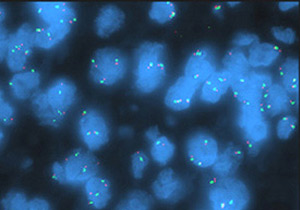
Locus-specific EGFR probe (orange) and centromere 7 probe (green): Not amplified
The Cytogenetics Core offers fluorescence in situ hybridization services for a variety of specimen types, including nonparaffin, paraffin and paraffin tissue microarray.
Fluorescence in situ hybridization can be performed to:
- Enumerate the copy number of cancer-related genes and patterns of gene-related gains and losses.
- Map the location of DNA sequences, genes or transgene insertions.
- Determine the presence or absence of interspecies cells in xenograft or chimeric animal models.
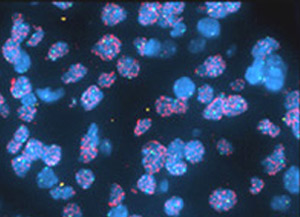
Locus-specific EGFR probe (orange) and centromere 7 probe (green): Amplified
Details
Nonparaffin FISH
The Cytogenetics Core processes and analyzes (counts) slides. This includes image documentation.
- Fluorescence in situ hybridization is performed on interphase or metaphase cells that have been dropped on a slide or grown on a cover slip.
- Samples may be in the form of cultured cells or fresh or frozen tissue.
- Specific cell types include blood, bone marrow, tumors, cell lines, xenografts, hybrid cells from chimeric animal models, neural stem cells and mouse embryonic fibroblasts.
Paraffin FISH
The Cytogenetics Core processes and analyzes slides. Analysis includes image documentation.
- Paraffin-embedded tissue must be cut 5 µm thick and mounted on positively charged slides.
Paraffin FISH tissue microarray (TMA)
Paraffin-embedded tissue cores must be sectioned 5 µm thick and mounted onto a single slide.
- TMA slide processing service. The Cytogenetics Core processes (deparaffinizes and sets up) slides.
- TMA analysis service. The core analyzes slides on a "per sample core" basis. Analysis includes image documentation.
FISH imaging only
The Cytogenetics Core or the customer sets up slides. Images are captured as the only result (no counting).
FISH probes
Inquire about commercially available probes:
- Centromere probes.
- Gene-specific probes.
- Locus-specific identifiers probes.
- Probe panels (several multicolor locus-specific identifiers in one probe mix).
- Telomere probes.
- Whole-chromosome paints.
- Whole-genomic paints.
The core also offers custom probe development.