Karolinska Institute cancer collaboration
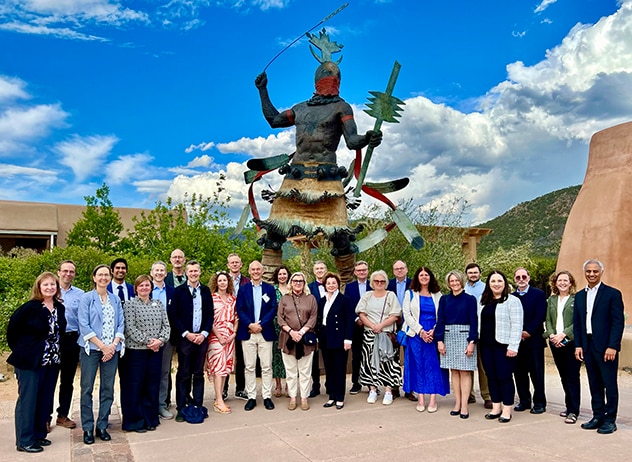
Representatives from Mayo Clinic Comprehensive Cancer Center and Karolinska Institute's Cancer Research KI gather for a retreat in Santa Fe, New Mexico.
Overview
Mayo Clinic Comprehensive Cancer Center and Cancer Research KI are collaborating to tackle some of the toughest challenges in cancer prevention, diagnosis and treatment.
The Cancer Center and Cancer Research KI have collaborated in the field of cancer research for many years. Cancer Research KI is an umbrella organization of cancer research at the Karolinska Institute in Sweden. It brings together more than 400 research groups, including Mayo Clinic, to foster high-impact research, support new scientists and accelerate the translation of scientific discoveries into patient care.
Through their partnership, Mayo Clinic Comprehensive Cancer Center and Cancer Research KI offer opportunities for cancer investigators to apply for grant funding for vital research projects.
Pilot project grants
In 2020, the Cancer Center and Cancer Research KI launched a collaborative request for applications (RFA) to fund breast cancer research through pilot project grants. The collaboration was expanded in 2022 to include calls for research on other solid tumors and hematologic malignancies.
As an adjunct to the pilot project awards, the Cancer Center and Cancer Research KI host a virtual joint research symposium annually in June. The symposium features presentations by the pilot project awardees and keynote presentations highlighting cancer research being conducted at each institution.
Synergy grants
In 2026, the two institutions developed a new grant mechanism called Synergy. Synergy grants are designed to bring together teams of investigators from the Cancer Center and Cancer Research KI to advance breakthroughs in risk assessment, early detection and interception of cancer.
These grants place special emphasis on funding projects that use or develop novel algorithms and methodologies in artificial intelligence (AI) and data-driven life science. They also emphasize emerging areas of science and technology at the interface of computational and digital biology, including mapping and computationally modeling spatial biology and spatial multi-omic ecotypes in cancer cells, tissues and organs.
A minimum of one project will be awarded.
The Synergy RFA seeks highly innovative approaches that may involve considerable scientific risk but could lead to new techniques, agents, methodologies, models and applications that have significant benefits for cancer research and patient outcomes.
Funding support through Synergy is expected to lead to impactful publications, discoveries and targeted submission of subsequent extramural peer-reviewed grants pursuing support from other sources. These submissions serve as the metrics of success for the Synergy grant program. In addition, grant awardees participate in regular follow-up monitoring to ensure that research progress is being made.
The 2026 Synergy RFA is now open. The submission deadline is Nov. 6, 2026.
Pilot project awardees
To date, 18 research projects with nearly four dozen investigators have been awarded pilot project grants totaling $1.7 million through the collaboration between Mayo Clinic Comprehensive Cancer Center and Cancer Research KI.
The awarded grants are in response to an ongoing initiative designed to enhance collaborations in cancer research between the two institutions. Our goal is to make a global impact on cancer through research that focuses on innovative scientific discovery and improvements in the diagnosis, prevention and treatment of cancer.
2026
Project: Preclinical development of the MTHFD1/2 inhibitor, TH9616, for the treatment of advanced breast cancer
Mayo Clinic: John R. Hawse, Ph.D.
Karolinska Institute: Thomas Helleday, Ph.D.
Project: Targeting oncogene-driven replication stress-induced DNA repair dependence in c-Myc overexpressed large B-cell lymphoma
Mayo Clinic: Thomas E. Witzig, M.D.; Zhenkun Lou, Ph.D.; Jithma P. Abeykoon, M.D.; Xiaosheng Wu, M.D.; Surendra Dasari, Ph.D.; Rebecca L. King, M.D.; Matthew J. Maurer, Sc.D., M.S.
Karolinska Institute: Olle Sangfelt, Ph.D.; Andrä Brunner, Ph.D.; Jinjiang Chou, Ph.D.; Aljona Malykova, M.D., Ph.D.
2025
Project: Novel tumor-targeting approaches for therapeutic RNA delivery
Mayo Clinic: Fabrice Lucien-Matteoni, Ph.D.
Karolinska Institute: Samir El Andaloussi
Project: Prophylactic and therapeutic immunotherapies against hepatitis C virus and hepatocellular carcinoma
Mayo Clinic: Michael A. Barry, Ph.D. and Richard Vile, Ph.D.
Karolinska Institute: Matti Sällberg
2024
Project: Unraveling the metabolic changes linking high mtDNA levels to increased lung tumor burden
Mayo Clinic: Taro Hitosugi, Ph.D.
Karolinska Institute: Nils-Göran Larsson
Project: A novel mode of Notch dysregulation in small cell lung cancer — Implications for therapy development
Mayo Clinic: Aaron S. Mansfield, M.D.
Karolinska Institute: Urban Lendahl
Project: Targeting both intracellular and extracellular domain of PD-L1 to overcome immunoresistance in TNBC
Formerly of Mayo Clinic: Xinyi Tu, Ph.D.
Karolinska Institute: Theodoros Foukakis
2023
Project: Development of extracellular vesicle biomarkers for CAR-T cell functions in lymphoma
Mayo Clinic: Saad J. Kenderian, M.B., Ch.B.
Karolinska Institute: Stephan Mielke
Project: Discovery of new therapies for the treatment of estrogen receptor positive breast cancer
Mayo Clinic: John R. Hawse, Ph.D.
Karolinska Institute: Oscar Fernandez-Capetillo
Project: Development of novel computational approaches to interpret and leverage multi-organ single-cell spatial profiling for comprehensive characterization of the triple-negative breast cancer tumor microenvironment
Mayo Clinic: Roberto A. Leon-Ferre, M.D., and J.C. C. Villasboas Bisneto, M.D.
Karolinska Institute: Jean Hausser
2022
Project: Multi-omics studies of BTK inhibitor resistance in chronic lymphocytic leukemia
Mayo Clinic: Neil E. Kay, M.D.
Karolinska Institute: Richard Rosenquist
Related publications
Project: Mutant p53 as a target to improve response to immune checkpoint blockade
Mayo Clinic: Keith L. Knutson, Ph.D.
Karolinska Institute: Galina Selivanova
Project: Development of targeted immunotherapy for malignant B cell lymphomas
Mayo Clinic: Zhi Zhang Yang, M.D.
Karolinska Institute: Qiang Pan-Hammarström
Related publications
Project: Artificial intelligence image-based model development and validation for long-term breast cancer risk assessment in Swedish and U.S. screening settings
Mayo Clinic: Celine M. Vachon, Ph.D.
Karolinska Institute: Mikael Eriksson
Related publications
Project: Pseudo-mutant p53: A predictor of leukemic transformation in clonal hematopoiesis
Mayo Clinic: Mrinal S. Patnaik, M.B.B.S.
Karolinska Institute: Klas Wiman
2021
Project: Novel NOTCH3-based therapies to inhibit the growth and immune evasion capacity of triple negative breast cancer
Formerly of Mayo Clinic: Tony B. D'Assoro, M.D., Ph.D.
Karolinska Institute: Urban Lendahl
Related publications
Project: Exploration of fibroblasts as biologically relevant biomarkers in breast benign disease
Mayo Clinic: Derek C. Radisky, Ph.D.
Karolinska Institute: Arne Östman
2020
Project: Identification of genetic variants as predictors of hematological toxicity of adjuvant chemotherapy in breast cancer
Mayo Clinic: Liewei Wang, M.D., Ph.D.
Karolinska Institute: Theodoros Foukakis
