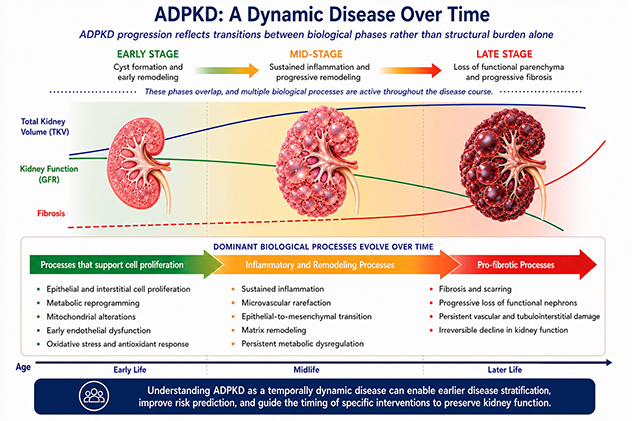
 Autosomal dominant polycystic kidney disease (ADPKD) as a dynamic disease over time
Evidence from experimental models and longitudinal studies in humans suggests that autosomal dominant polycystic kidney disease progression reflects overlapping biological phases that evolve over time, with the dominant biological processes varying across different stages of disease.
Overview
The Vascular Biology and Biomarker Discovery in Polycystic Kidney Disease Laboratory directed by Maria V. Irazabal Mira, M.D., Ph.D., studies the mechanisms that drive kidney injury and disease progression in autosomal dominant polycystic kidney disease. The lab combines preclinical models, advanced imaging, vascular biology, metabolomics and translational studies in patients with autosomal dominant polycystic kidney disease to identify early, disease-specific biomarkers of severity and progression and uncover new pathways for therapeutic intervention.
Autosomal dominant polycystic kidney disease is one of the most common inherited kidney diseases and a major cause of kidney failure worldwide. However, disease progression varies widely among people, and current clinical markers often detect damage only after substantial structural changes have occurred.
Research in the Irazabal lab focuses on understanding the biological changes that precede irreversible kidney injury. By studying autosomal dominant polycystic kidney disease as a dynamic disease that evolves over time, the lab aims to better understand how vascular, metabolic, mitochondrial and redox abnormalities develop from the earliest stages of disease and contribute to progression before traditional markers of kidney function decline.
Current research focuses on developing and validating imaging, as well as vascular, metabolic and molecular biomarkers that may improve risk stratification, disease monitoring and early assessment of disease progression.
The lab's recent work has advanced the understanding of intrarenal microvascular disease in autosomal dominant polycystic kidney disease. Part of this work, which was featured on the cover of the Journal of the American Society of Nephrology, has contributed to the first clinical studies using ultrasound localization microscopy to assess the renal microvasculature in patients with autosomal dominant polycystic kidney disease.
One major contribution from Dr. Irazabal is the development of the Mayo Image Classification for autosomal dominant polycystic kidney disease. This classification system is now widely used nationally and internationally for risk stratification, clinical trial design and patient management.
The lab is building on these efforts by refining imaging, as well as vascular, metabolic and molecular approaches, to better predict disease progression and identify patients who may benefit most from early therapeutic intervention.
Main areas of research include:
- Predictive models and imaging biomarkers in autosomal dominant polycystic kidney disease.
- Endothelial dysfunction and microvascular abnormalities in autosomal dominant polycystic kidney disease.
- Development of noninvasive approaches to assess the renal microvasculature.
- Oxidative stress and redox signaling.
- Mitochondrial structure, function and metabolic dysregulation.
The Irazabal lab is affiliated with:
The lab collaborates with experts in nephrology, radiology, cardiovascular medicine, imaging sciences and metabolomics.