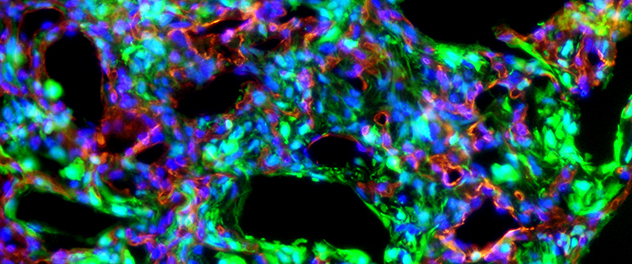
Lung tissue exhibits profound cellular remodeling and fibrosis.
Discovering novel regulators of fibroblast biology
In this discovery-oriented project, the Tissue Repair and Mechanobiology Lab is using screening approaches, including RNA interference, RNA sequencing, assay for transposase-accessible chromatin sequencing, and small molecule libraries to identify novel gene and molecular regulators of fibroblast function. Performing high-content image analysis helps the research team assess functional outcomes, including fibroblast cytoskeletal remodeling and matrix synthesis.
The lack of therapies to arrest or reverse fibrosis represents a significant unmet clinical need. Pathways known to be important in fibroblast activation, such as transforming growth factor beta and Rho kinase, are challenging to target because of their important pleiotropic contributions to homeostasis and health. Thus, new targets to selectively regulate fibroblast biology are needed, particularly targets that can reverse fibroblasts from fibrotic to reparative states.
The long-term goal of this project is to develop a systematic understanding of fibroblast biology and identify novel targets by which the functions of this cell type can be therapeutically modified. Dr. Tschumperlin and colleagues hope to find new approaches for arresting or reversing progressive fibrosis and facilitating tissue repair.