 Understanding stiffening in lung tissue
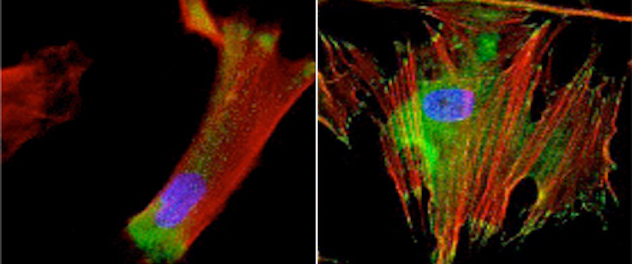
Dr. Tschumperlin's lab studies how fibroblasts cause and feed into the progressive stiffening of lung tissue in pulmonary fibrosis to find novel regulators for therapeutic targeting. Above, human lung fibroblast on soft (left image) and stiff (right image) substrates display characteristic differences in morphology and cytoskeletal organization.
Mechanobiology of pulmonary fibrosis
The Tissue Repair and Mechanobiology Lab's research on the mechanobiology of pulmonary fibrosis aims to precisely define the spatial and temporal changes in tissue stiffness that accompany fibrosis and identify the signaling mechanisms that regulate activation of fibroblasts. The research team uses model systems and human disease-derived cells and tissues.
Fibrosis is a pathobiological process common to many tissues and diseases that results in tissue remodeling and loss of function, often necessitating organ replacement or leading to end-stage disease. Fibrosis occurs through fibroblast activation, predominantly in soft tissues such as the lungs, liver, kidneys, heart and skin. Activated fibroblasts are contractile, proliferative and resistant to apoptosis, and they are responsible for the excess deposition of the extracellular matrix. The lab also is exploring whether activated fibroblasts can be triggered to degrade extracellular matrix during resolution of fibrosis and whether this capacity can be leveraged for new therapies.
The long-term goal of the lab's pulmonary fibrosis research is to elucidate molecular mechanisms of stiffness-dependent fibroblast activation and mechanisms to coordinate reversal of matrix stiffening, thus identifying novel regulators of fibrosis suitable for therapeutic targeting.