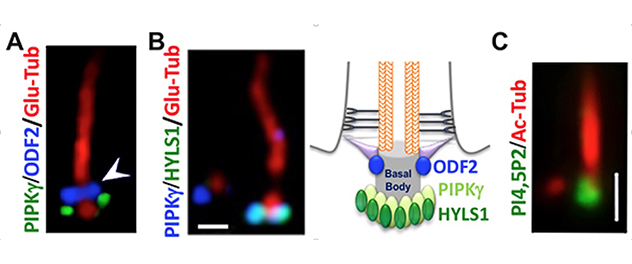
 PIPKIγ and the ciliopathy protein HYLS1 form a complex to produce PtdIns(4,5)P2 at the ciliary base.
The specific PtdIns(4,5)P2 pool at the ciliary base is essential for the guided transportation of ciliary proteins into the primary cilium.
Skeletomuscular development and disease
The skeleton muscle, bone and fat tissues are differentiated from the same type of progenitor cells. Using conditional PIPKIγ knockout mice, our team found that PIPKIγ not only participates in the differentiation of osteoblasts and adipocytes from progenitor cells but also is required to maintain and grow skeletal muscle by regulating mitochondria and lipid droplets.
Among the three PtdIns4P-5-kinases, PIPKIγ is the only one that causes severe developmental defects and lethality when knocked out in mice. Moreover, a missense mutation in PIP5K1C that encodes a kinase-dead PIPKIγ is associated with lethal congenital contractural syndrome type 3 (LCCS3), which is embryonic lethal and exhibits severe muscle waste. The goal of our study is to understand how PIPKIγ and PtdIns(4,5)P2 regulate the differentiation, growth and homeostasis of bone, muscle and fat tissues.