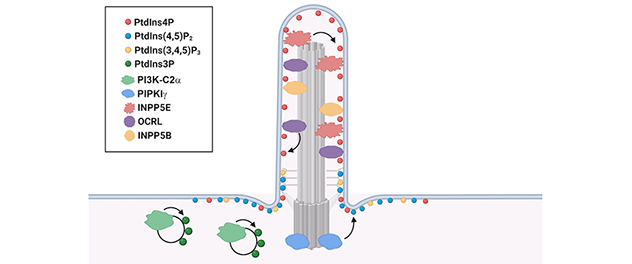
 Localization of phosphoinositides with associated phosphatases and kinases in primary cilia
Specific phosphatases and kinases support the enrichment of unique phosphoinositide species in different ciliary compartments.
Polycystic kidney disease
Polycystic kidney disease (PKD) — a group of genetic conditions with progressive renal cysts — is the most common genetic cause of kidney failure. PKD genes encode proteins that localize in primary cilia or regulate ciliary proteins. The genes most often changed in patients with PKD are PKD1 and PKD2, encoding polycystin-1 and polycystin-2, respectively. Polycystin-1 and polycystin-2 form a complex that localizes in primary cilia and functions as a cation channel.
Accumulating evidence suggests that the level of functional polycystin complex in primary cilia is associated with the progression and severity of renal cystogenesis. Importantly, restoration of functional polycystins in cilia suppresses and even reverses the disease in mouse models of PKD.
Our work suggests that a unique cilium-specific phosphoinositide signaling axis regulates the ciliary entry and homeostasis of polycystins. Our team's efforts focus on dissecting the underlying molecular mechanism and discovering molecules that can be targeted to restore the appropriate level of polycystin complex in cilia in the context of PKD.