Epithelial-to-mesenchymal transition and cancer metastasis
The epithelial-to-mesenchymal transition is a key event for typical embryonic development, wound healing and tissue regeneration, as well as organ fibrosis and cancer metastasis. Via this highly dynamic process, epithelial cells convert into mesenchymal phenotypes. They become less differentiated and more migratory and invasive. Morphologically, the epithelial-to-mesenchymal transition starts from the disassembly of cell-cell adhesion and loss of epithelial polarity, and then active assembly of dynamic cell-matrix adhesions and migration.
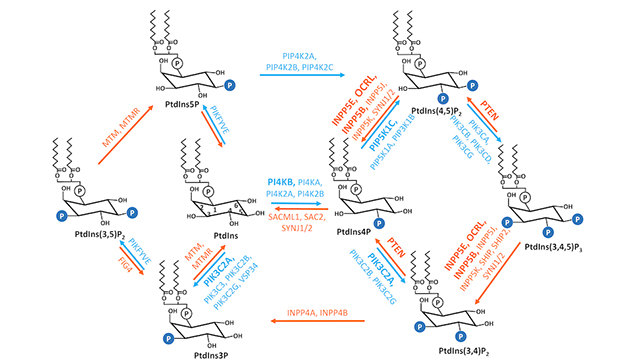 Interconversions of 7 phosphoinositide metabolites
Phosphoinositides, reversibly phosphorylated derivatives of the membrane phosphatidylinositol, are low abundant secondary messengers. They serve as key identity determinants of various cellular membrane compartments and act as spatiotemporal cues to direct signaling events. As such, phosphoinositides are indispensable to the integrity of cells.
Phosphatidylinositol-4,5-bisphosphate, abbreviated as PtdIns(4,5)P2, is a key regulator of cell adhesions and the actin cytoskeleton besides functioning as a substrate of phospholipase C (PLC) and phosphoinositide 3-kinase (PI3K) to influence signaling events in the epithelial-to-mesenchymal transition. PtdIns(4,5)P2 directly regulates the epithelial-to-mesenchymal transition from multiple aspects, including gene transcription, protein stability, targeted vesicular trafficking and the interaction between adhesion proteins.
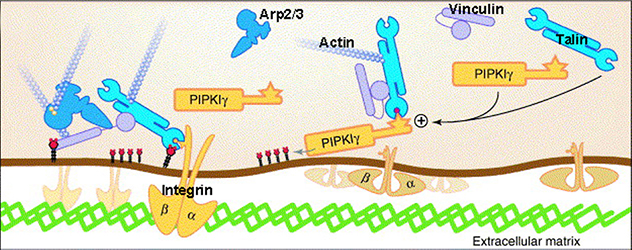 Phosphatidylinositol-4,5-bisphosphate regulates the assembly of focal adhesions and cell migration
Phosphatidylinositol-4,5-bisphosphate binds to talin and promotes the interaction of talin with integrin.
The lab's team and others have observed that Type I gamma phosphatidylinositol phosphate kinase (PIPKIγ), the dominant generator of PtdIns(4,5)P2, directly binds to multiple structural and signaling molecules to support these processes. The intent of our lab is to understand the underlying molecular mechanisms and molecules that can be targeted to manipulate these important life events.
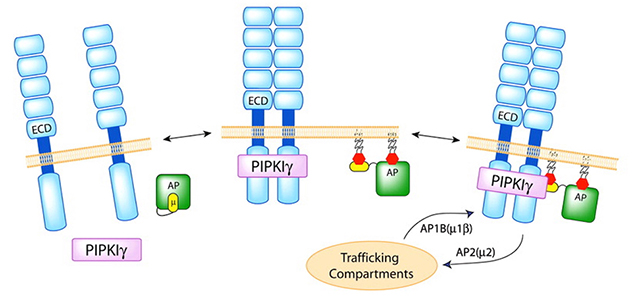 Phosphoinositide signaling regulates the polarized vesicular trafficking
Type I gamma phosphatidylinositol phosphate kinase (PIPKIγ) specifically targets to, and creates a pool of, phosphatidylinositol-4,5-bisphosphate at the nascent adherence junctions. This serves to guide the directed deposition of E-cadherin and facilitates the maturation of adherence junctions and epithelial polarization.