-
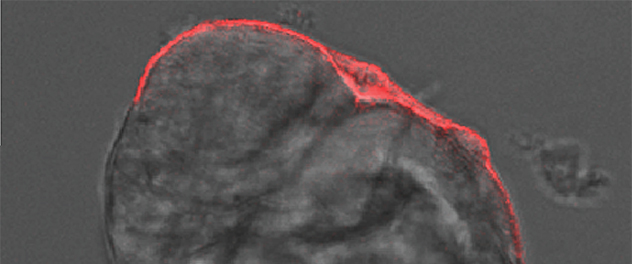
Reconstructing epithelial-mesenchymal interactions
A primary lung fibroblast (red) wrapping an AT2 organoid.
-
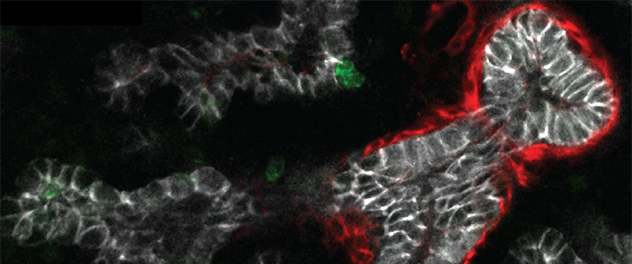
Mapping the emergence of AT2 cells in vivo
Confocal image of an embryonic mouse lung wherein AT2s (green) can be seen emerging in an intermediate zone between the distal tips and more proximal branch stalks wrapped by airway smooth muscle cells (red).
-
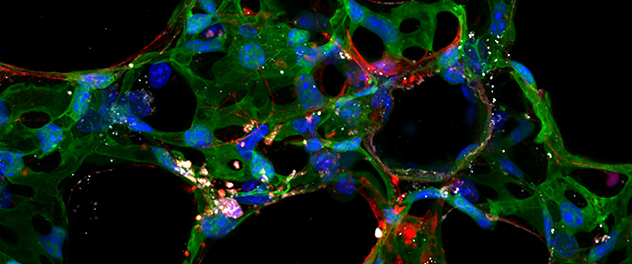
Visualizing the lung repair process
Confocal image of an injured mouse lung wherein AT1s (red) can be seen undergoing apoptosis (white).
-
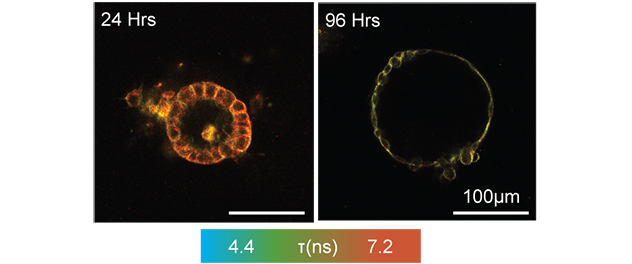
Investigating biophysical regulation of cell fate
Fluorescent lifetime microscopy of an embryonic lung progenitors at day 1 and 4 of differentiation into alveolospheres shows a change in cell membrane tension (color indicates mean weighted arrival time).
-
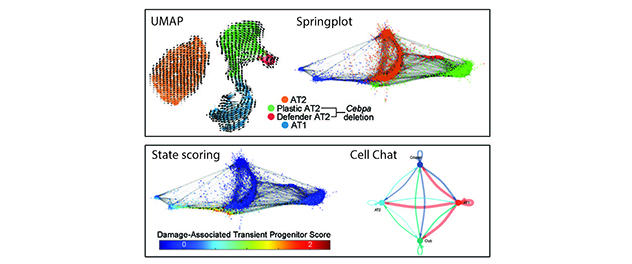
Bioinformatic interrogation of the lung epithelium
Representative analysis of single cell RNA-sequencing data wherein changes in cell dynamics and signaling can be observed.
Overview
The Lung Development and Regeneration Lab of Douglas G. Brownfield, Ph.D., investigates how the lung builds, maintains and repairs alveoli across the lifespan — and why these processes fail in disease. We combine developmental biology, mechanobiology, single-cell genomics and organoid engineering to uncover the molecular and physical principles that govern epithelial identity, plasticity and regeneration.
Our research spans mouse and human development, adult injury and repair, and disease contexts such as fibrosis. We integrate live imaging, fluorescence lifetime imaging microscopy (FLIM)-based membrane mechanics, engineered mouse models, and 3D co-culture and organoid systems with computational single-cell analysis to map how epithelial cells sense their environment and decide between stemness, differentiation or maladaptive transitional states.
A central theme of the lab is that genes alone do not dictate cell fate. Instead, we explore how mechanical forces, membrane tension, signaling pathways and niche interactions converge to shape lineage decisions during alveolar development and repair.
Our multidisciplinary team uses these insights to identify fundamental principles of tissue regeneration and develop novel strategies to restore lung function. These strategies range from engineering pro-regenerative microenvironments to reactivating developmental programs in injured or fibrotic tissue.
We welcome trainees who are excited by creative, boundary-crossing science at the intersection of development, mechanics, regeneration and computation, and who want to contribute to a collaborative effort to understand and therapeutically harness the rules of lung biology. These trainees can come from any Mayo Clinic Graduate School of Biomedical Sciences track, including: