 Innovating regenerative neuroimmunology to improve recovery after neural injury
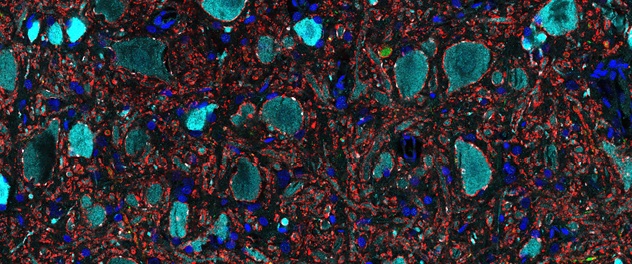
Dr. Siddiqui's lab develops combinatorial regenerative therapies that modulate neuroinflammation and promote recovery after spinal cord injury. The image above shows colabelling of synaptic boutons (red; synaptophysin) with DAPI-labelled nuclei (blue), ChAT-positive motor neurons (teal) and calbindin-positive interneurons (green) in the murine spinal cord using immunohistochemistry and confocal imaging.
Overview
The Regenerative Neuroimmunology in Neural Injury and Repair Laboratory at Mayo Clinic, led by Ahad M. Siddiqui, Ph.D., studies and develops therapies that help control inflammation in the body after neurological injury. These therapies can make it easier for the body to repair damaged tissue and help patients regain abilities that they may have lost because of injury to the brain or nervous system.
Dr. Siddiqui's laboratory works at the intersection of biomaterials, cell and gene therapies, neuromodulation, and machine learning-enabled imaging analysis. The research team uses approaches such as novel biomaterials, cell and gene delivery, electrical stimulation, and extracellular vesicles to improve neural regeneration and functional outcomes.
The lab's overall goal is to develop combination strategies, also called combinatorial therapies. These therapies may overcome the complex biological barriers to regrowing damaged parts of the nervous system, a process known as neural regeneration. Combinatorial therapies may support neural regeneration through enhanced neuroprotection, regeneration and neural plasticity.
Improving patient outcomes after spinal cord injury
Neural injuries, such as traumatic spinal cord injury, often lead to permanent disability because the central nervous system has a limited capacity for self-repair. After the initial trauma, a hostile microenvironment — characterized by cell death, inflammation, inhibitory molecules and demyelination — prevents effective regeneration and functional recovery. Current treatment options do not sufficiently address these secondary pathological events, leaving a significant unmet need for interventions that both protect neurons and stimulate repair.
The Regenerative Neuroimmunology in Neural Injury and Repair Laboratory develops regenerative therapies that target multiple aspects of the injury cascade to improve outcomes for people who have had spinal cord injuries.
Focus areas
The laboratory takes several complementary approaches to neural repair, including:
- Reducing inflammation after injury to protect cells.
- Developing supportive structures called biomaterials that help guide neuronal growth and healing.
- Creating cell-based and gene-based therapies that deliver healing signals directly to injured tissue.
- Combining proven treatments to address multiple barriers to recovery at once.
- Using naturally released cell particles called extracellular vesicles (EVs) that can deliver healing signals and help monitor recovery.
- Leveraging artificial intelligence (AI) and machine learning tools to improve how healing is measured in research studies.
Key findings
Dr. Siddiqui's research team has shown that:
- Engineered biomaterials can support nerve cell attachment and growth after spinal cord injury.
- Combining different treatment approaches is more effective than using a single therapy alone.
- Early control of inflammation may help reduce long-term damage.
- Computer-assisted image analysis improves accuracy and consistency in spinal cord research.
Advancing spinal cord care
The Regenerative Neuroimmunology in Neural Injury and Repair Laboratory is focused on turning today's discoveries into future treatments that may improve care for people with spinal cord injuries. The research team works toward this goal by:
- Breaking through regenerative barriers. Dr. Siddiqui's lab develops therapies that go beyond treating the initial injury to address the ongoing biological changes that make it difficult for the spinal cord to heal.
- Accelerating preclinical discoveries. The research team studies combined, flexible treatment approaches that better reflect the complex nature of spinal cord injury, helping move promising therapies more efficiently into patient care.
- Improving research precision and reliability. The lab uses AI tools to more accurately analyze research data, leading to more reliable results and faster progress toward new treatments.
- Advancing EV theranostics for targeted care. Theranostics combine therapy and diagnostics. They provide treatment while at the same time taking measurements of the patient's injury, healing or both. The lab explores the use of EVs as precision theranostic tools to deliver therapies to injured nerve tissue while also measuring recovery. The goal is to create safer, more targeted and more personalized treatments for spinal cord injury.
- Expanding therapeutic possibilities. The laboratory's current research lays the groundwork for future care that combines supportive biomaterials, cell-based treatments and nerve stimulation to help promote nerve repair and recovery.
Affiliations
The Regenerative Neuroimmunology in Neural Injury and Repair Laboratory works with experts from research and clinical areas and education programs across Mayo Clinic.