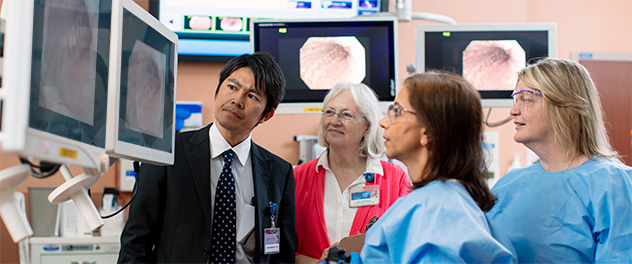
 Innovation in gastrointestinal endoscopy
Disruptive innovation in endoscopy pushes our team to imagine beyond the bounds of possibilities to transform patient care through minimally invasive endoscopic approaches.
Overview
Gastrointestinal endoscopy has experienced a rapid increase in innovations designed to improve quality of life for patients. Diagnostic and therapeutic device and technology development plays a crucial role in transforming patient care. Physician innovators draw from their daily experience to identify clinical needs and develop novel products and solutions. Recent advances in the field of gastrointestinal endoscopy are third-space endoscopy, endobariatrics and artificial intelligence (AI).
The mission of our laboratory is to advance innovation in endoscopy for the well-being of patients.
We have five main research goals:
- Innovating and developing devices and technology to address gaps and deficiencies in the practice of gastrointestinal endoscopy.
- Implementing new devices or techniques into clinical practice.
- Evaluating functionality of prototype devices and effectiveness of novel techniques.
- Designing and conducting studies for medical device companies seeking premarket approval or premarket notification 510(k) from the U.S. Food and Drug Administration, including labs that are compliant with good laboratory practice (GLP) standards.
- Offering education and training in advanced endoscopic procedures.
Ongoing research in our lab aims to advance the diagnosis and treatment of several conditions through minimally invasive endoscopic techniques. Our main areas of research include:
- Gastrointestinal cancer models.
- Endoscopic ultrasound and endoscopic retrograde cholangiopancreatography.
- Gastrointestinal bleeding.
- Obesity.
- Gastroesophageal reflux disease.
- Capsule endoscopy.
- Tissue resection and endoscopic ablation.
- Advanced diagnostic imaging techniques.
- AI for diagnostic endoscopy.
Principal investigators
Our lab's three principal investigators are also practicing gastroenterologists at Mayo Clinic in Rochester, Minnesota.
Elizabeth Rajan, M.D., serves as director of the Developmental Endoscopy Lab. Dr. Rajan's research goal is to develop unique tools that improve patient quality of life. New and disruptive innovations can advance the diagnosis and management of such diseases as colorectal cancer and gastroparesis.
Jad P. AbiMansour, M.D., is director of industry engagement for the lab, fostering collaboration with medical device companies to advance minimally invasive technologies. He also leads the lab's educational efforts to upskill practitioners on novel endoscopic techniques developed across the field. His clinical expertise includes advanced and complex endoscopy procedures, with a focus on pancreaticobiliary disease. Dr. AbiMansour is actively involved in research to develop next-generation endoscopic solutions.
Cadman L. Leggett, M.D., is director of AI and gastrointestinal oncology within the lab, specializing in esophageal disorders and advanced endoscopic imaging. His work focuses on integrating artificial intelligence into diagnostic endoscopy to improve accuracy and patient outcomes.
Collaboration opportunities
Our lab collaborates with companies and researchers with a shared commitment to advancing patient care through breakthrough endoscopic solutions. Email us to discuss collaboration opportunities.