 Cellular and molecular mechanisms of neurodegeneration
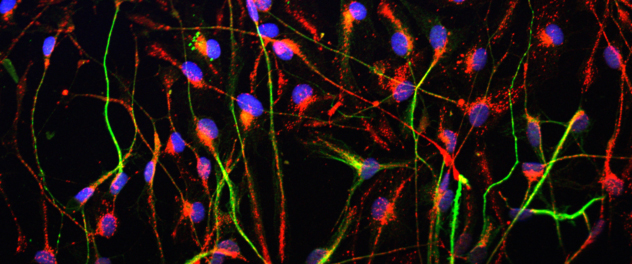
The research team uses a broad range of models and techniques to uncover the cellular and molecular mechanisms of neurodegenerative disorders, such as differentiated neurons stained by immunofluorescence.
Overview
The Cellular Mechanisms of Neurodegenerative Disorders Laboratory at Mayo Clinic, led by Fabienne C. Fiesel, Ph.D., investigates the role of ubiquitin and ubiquitin-like modifiers for neurodegenerative diseases. These modifiers are small proteins that attach to other proteins, thereby altering their function or cellular fate. Dr. Fiesel's lab specifically focuses on dissecting the molecular and cellular function of ubiquitin-like disease modifiers in Parkinson's disease, Alzheimer's disease and other related tauopathies.
The lab focuses on two pathways:
- UFM1. This understudied ubiquitin-like modifier broadly links to stress pathways. UFM1 has been implicated in Alzheimer's disease, and it has been shown to affect tau aggregation in cells.
- PINK1-PRKN. This mitochondrial quality control pathway is driven by ubiquitin signaling. It is genetically linked to early-onset Parkinson's disease.
For its research, the lab uses cell culture models, including induced pluripotent stem cells, CRISPR gene editing techniques, as well as mouse models and human postmortem brain samples. These models help the lab study the functions of UFM1 and PINK1-PRKN pathobiology in the brain.
The lab performs a wide range of molecular, cellular and biochemical techniques, as well as state-of-the-art imaging. This imaging includes high-content, live cell, super-resolution and automated slide-scanning microscopy.