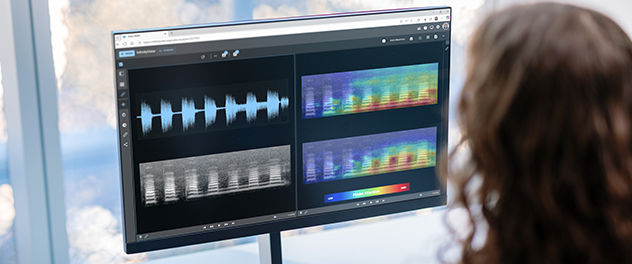
 Visualizing speech and model results in InfinityView
A researcher examines audio visualizations and model attention heat maps.
Overview
The Speech Innovation Group in Neurology, Artificial Intelligence and Linguistics Laboratory led by Hugo Botha, M.B., Ch.B., and Rene L. Utianski, Ph.D., CCC-SLP, is developing objective, technology-enabled biomarkers of speech and language impairment in neurodegenerative disease. The lab focuses on frontotemporal degeneration syndromes, including:
The lab's work integrates acoustic signal processing, natural language processing and digital assessments to quantify disease presence, subtype and progression. The lab aims to accelerate early diagnosis and remote monitoring by moving speech-language assessment out of the specialty clinic and into the home with an exam that can be completed anywhere in as little as three minutes.
The lab leverages the intersection of neurology, speech pathology, artificial intelligence (AI) and linguistics to build tools that approximate the clinical decisions of expert listeners. The lab uses its experienced clinicians' judgments as the standard to test its technology.
By applying advanced AI, the lab aims to shorten the time to diagnosis and support more-precise predictions about a person's disease course. The lab is committed to creating noninvasive, digital solutions that can expand the availability of Mayo Clinic's expertise well beyond its walls.
The lab's research shows that speech is one of the most sensitive indicators of brain health, often changing years before other clinical symptoms appear. Studies suggest that automated, objective analysis of speech can detect the presence of motor speech disorders and even distinguish between different types of motor speech disorders. The lab's work also shows that automated analyses of brief recordings that describe a provided picture can distinguish between those without cognitive difficulties and those with mild cognitive impairments and dementia.
The principal investigators also serve as the primary clinicians in Mayo Clinic's Primary Progressive Aphasia and Apraxia of Speech Clinic. This ensures that patterns seen in the clinic guide the research program and that the lab can shorten the timeline from making advances to benefiting from those advances in the clinic.
About speech and language disorders
Language is the mental system of symbols and rules. It's how people choose words, put them in the right order and understand what others are saying.
If a person has the thought but can't find the word for coffee, that is a language issue. When a person has difficulty processing language, including speaking, understanding, and reading or writing, that is referred to as aphasia. When this occurs as the first sign of a degenerative disease, it is often called primary progressive aphasia.
Speech is the physical act of producing sounds. It involves the coordinated movement of a person's tongue, lips, vocal cords and lungs.
If a person knows the word "coffee," but that person's tongue won't move to the right spot to make the "k" sound, either from weakness, incoordination or planning difficulties, that is a speech issue. Difficulties with speech can be in planning or programming the message from the brain to the muscles. This is called apraxia of speech. Or these difficulties could be due to executing the muscle movements themselves. This is called dysarthria.