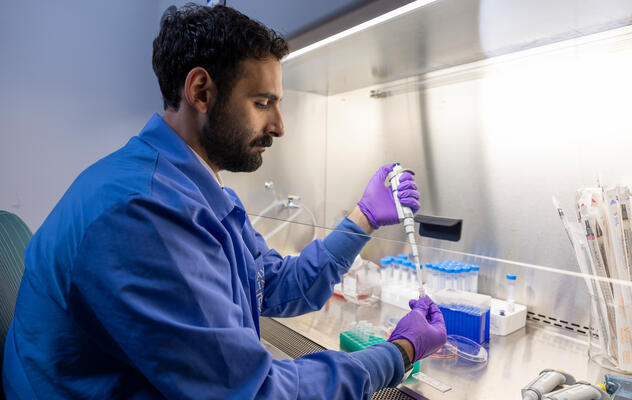
A lab member performs molecular and cellular experiments to uncover disease mechanisms and identify novel therapeutic targets for kidney disease.
Research projects
The Chebib lab has numerous research focus areas related to autosomal dominant polycystic kidney disease (ADPKD).
Mechanisms of cystogenesis and disease progression
We investigate how disruptions in polycystin signaling, calcium homeostasis and cAMP pathways drive epithelial proliferation and cyst expansion. Our emphasis is on identifying actionable therapeutic targets and pathways.
Vasopressin-independent water regulation pathways
Our laboratory has identified novel signaling pathways that link intracellular urate transport to aquaporin-2 trafficking. This discovery defined a new paradigm of renal water handling independent of vasopressin. These pathways represent a foundation for first-in-class therapeutic development.
Mechanotransduction and tubular remodeling
We study how mechanical sensing and mechanosensitive ion channels regulate tubular architecture and cyst initiation. We investigate how these pathways can be pharmacologically targeted to suppress cyst growth.
Genotype-phenotype integration and disease heterogeneity
Using deeply phenotyped clinical cohorts, we define how genetic variation across polycystic kidney disease genes influences disease severity, imaging patterns and outcomes. This enables more precise prediction of disease trajectory.
Radiomics, imaging biomarkers and AI-driven prediction
Our team develops and validates advanced imaging biomarkers and artificial intelligence (AI) models that integrate imaging, genetic and clinical data to improve risk stratification and design of clinical trials.
Translational therapeutics and clinical trials
We design and lead investigator-initiated and multicenter clinical trials aimed at addressing unmet needs in ADPKD. Our approach is multifaceted. It includes enriching trials with appropriately selected patient populations to accelerate translation of novel therapies. It also includes developing refined risk-stratification models that integrate clinical, genetic and imaging biomarkers. And it includes optimizing treatment tolerability by mitigating therapy-related adverse effects and improving adherence. Collectively, these strategies aim to expand and personalize therapeutic options.
Gene therapy and kidney reprogramming
We're developing gene-based therapeutic strategies for monogenic kidney diseases. These include ex vivo kidney perfusion platforms that enable targeted delivery of genetic and molecular therapies to the intact kidney. Through this approach, we aim to reprogram disease-relevant cellular pathways, correct underlying molecular defects, and restore or preserve kidney function.
Intracellular urate signaling to suppress cystogenesis
We're developing small-molecule modulators of the urate-PDE-AMPK-AQP2 axis as vasopressin-independent therapies to reduce cAMP signaling, restore water reabsorption and inhibit cyst growth.
Precision imaging and radiogenomics in ADPKD
We integrate quantitative imaging, cyst distribution metrics and genetic data to develop next-generation predictive models that outperform current classification systems. These models can identify people most likely to experience near-term progression of their condition. This enables clinical trial enrichment by improving cohort selection, increasing statistical power, and reducing trial size and duration.
Mechanotransduction as a therapeutic target
We're characterizing mechanosensitive signaling pathways in cyst initiation and progression, with pharmacological modulation strategies to inhibit cyst expansion.
Clinical trials innovation
Our lab team designs and executes translational clinical trials. These include repurposing strategies and novel therapeutics aimed at improving efficacy, tolerability and patient-centered outcomes.
Gene therapy and ex vivo kidney reprogramming
We develop gene delivery platforms and ex vivo perfusion systems to enable targeted correction of pathogenic pathways and reprogramming of affected kidneys.
Genotype-informed disease modeling
We perform modeling using large-scale clinical and imaging datasets to define genotype-specific disease trajectories and refine individualized risk prediction.