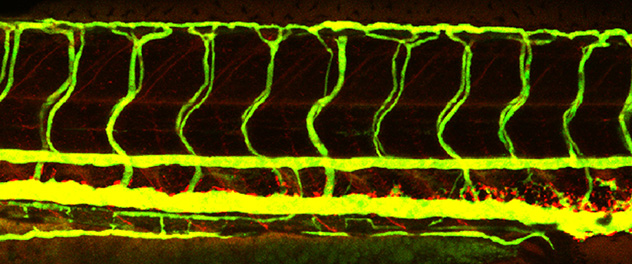
 Investigating disease mechanisms
This zebrafish model is one example of our lab's efforts to learn more about how vascular changes contribute to a range of diseases and conditions.
Overview
The Microenvironments and Applied Nanomedicine Laboratory is dedicated to advancing precision medicine through cutting-edge research on nanomedicine, cancer biology, neuroscience and cardiovascular science. The lab, based at Mayo Clinic in Jacksonville, Florida, is directed by principal investigator Dev Mukhopadhyay, Ph.D.
By combining state-of-the-art imaging and nanotechnology and discovery driven by artificial intelligence (AI), we aim to unravel the molecular mechanisms of disease and develop innovative therapies that improve patient outcomes.
Our work spans multiple focus areas:
- Nanomedicine and drug delivery. We engineer lipid-based and polymer-based nanoparticles for targeted delivery of chemotherapy, gene therapy and cancer vaccines. Our goal is to enhance efficacy, overcome resistance and minimize side effects.
- AI-driven drug discovery. Using artificial intelligence, molecular modeling and advanced validation tools, we have pioneered first-in-class inhibitors targeting previously undruggable proteins in pancreatic cancer.
- Cerebrovascular disease and brain health. Our research explores how blood-brain barrier dysfunction and vascular changes contribute to aging and neurodegenerative conditions such as Alzheimer's disease. We use zebrafish and other models for real-time vascular imaging.
- Cardiovascular disease. We're investigating the role of vascular endothelial growth factor (VEGF) signaling in heart disease and regeneration, aiming to identify novel pathways to restore healthy cardiac function.
- Biophysical cancer profiling. We're advancing personalized oncology care by leveraging atomic force microscopy and Raman spectroscopy to integrate biophysical and molecular data to predict therapeutic response.
- Electrical fields in pancreatic cancer. We're studying the effects of low-intensity, intermediate frequency and alternating electrical fields in disrupting cancer cell proliferation from different perspectives, including effects in the stroma, RAS pathways and immunogenic tumor microenvironment activation. We have specialized instrumentation to study electrical fields, known as tumor-treating fields.
About Dr. Mukhopadhyay
Dr. Mukhopadhyay is a professor of biochemistry and molecular biology at Mayo Clinic College of Medicine and Science. He has the distinction of being named the Mary Lowell Leary Professor. Dr. Mukhopadhyay's training and expertise in angiogenesis, cancer, cardiovascular diseases and other conditions fuel his passion for research on the microenvironment.