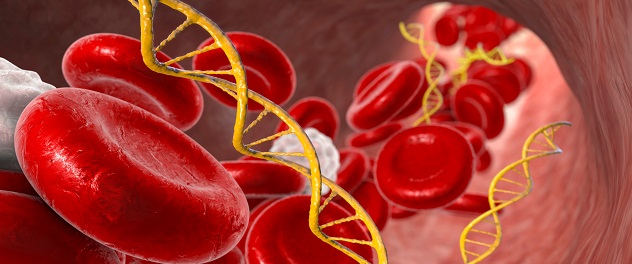
 Liquid biopsy for personalized diagnosis and treatment
Dr. Chaudhuri's lab tests easily obtained samples, such as blood, to find cancer early, learn more about it and develop treatments unique to each patient.
Overview
Led by Aadel A. Chaudhuri, M.D., Ph.D., the Liquid Biopsy and Immunogenomics Laboratory at Mayo Clinic analyzes blood and other minimally invasive biofluids to derive complex information about individual patients' cancers. These "liquid biopsies" provide a wealth of knowledge that can help guide treatment, including the presence and biological state of a tumor, the tumor microenvironmental profile, how sensitive the cancer may be to treatment, and the patient's risk of recurrence.
Technologies developed and applied by Dr. Chaudhuri's laboratory include:
- Cell-free DNA (cfDNA) methylome profiling for noninvasive characterization of tumors and their microenvironments.
- Circulating tumor DNA (ctDNA) minimal residual disease and molecular response assessment.
- Whole-genome sequencing for copy number and fragmentomic analysis.
- Targeted deep sequencing for sensitive detection of tumor-associated mutations.
- Spatial and single-cell transcriptomic profiling of tumor ecosystems.
- Computational deconvolution and machine learning approaches for inferring cellular states and gene expression programs.
- Immune and tumor cell-state profiling to understand therapeutic response, resistance and toxicity.
- Analysis of plasma, urine, lymphatic and other proximal biofluids for cancer detection and disease monitoring.
Together, these methods form an integrated translational research program aimed at finding and treating cancer earlier, with methods that are more precise, more dynamic and less invasive.
Recent discoveries
A major advance from Dr. Chaudhuri's research program was reported in Nature in 2026. By studying millions of individual cells across many cancer types, Dr. Chaudhuri and colleagues identified nine major tumor microenvironment patterns, also called spatial ecotypes or microenvironmental neighborhoods. Importantly, these neighborhoods carried meaningful clinical information. Some were linked to better outcomes and responses to immunotherapy, while others were linked to treatment resistance.
The team then made a key conceptual leap. The lab showed that these same tumor microenvironmental neighborhoods could be detected through a simple blood test. Using AI to analyze methylation patterns in cell-free DNA circulating in the bloodstream, Dr. Chaudhuri and colleagues developed a noninvasive window into the tumor microenvironment. This allowed them to gather biological information that traditionally could only be obtained from tumor tissue. This work represents a major expansion of what liquid biopsy can reveal, moving beyond simply detecting or measuring cancer to understanding the biological ecosystem surrounding it.
Ultimately, this approach could shift the paradigm in helping care teams predict which treatments are most likely to work and monitor how cancer changes during treatment.
About Dr. Chaudhuri
Dr. Chaudhuri began his scientific training at the Massachusetts Institute of Technology in the laboratory of Nobel laureate Dr. Phillip Sharp. He continued his work at the California Institute of Technology with Nobel laureate Dr. David Baltimore, where he led foundational studies of microRNAs in cancer and immunity. During residency and postdoctoral training at Stanford University with Dr. Maximilian Diehn, he led a seminal Cancer Discovery study establishing ctDNA as a powerful approach for detecting minimal residual disease following curative-intent cancer therapy.
Dr. Chaudhuri's work demonstrated that ctDNA could identify molecular evidence of residual cancer months before radiographic recurrence. His research also helped establish the conceptual and technical foundation for the modern ctDNA minimal residual disease field. The paradigm has since become a major tenet of precision oncology. Approaches grounded in ctDNA minimal residual disease are incorporated widely into prospective clinical trials, cancer drug development programs and commercial diagnostic platforms.