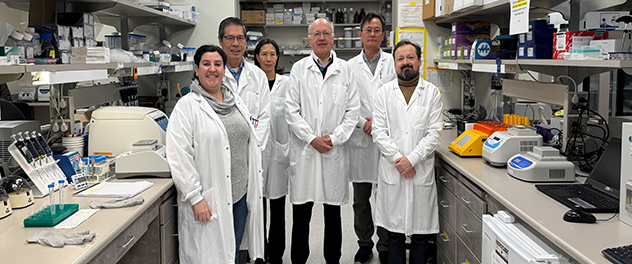
 Development and Recharge Facility
The Development and Recharge Facility enables an enhanced understanding of the epigenomic basis of human disease and facilitates the incorporation of advanced epigenomic technologies into basic, translational and clinical research at Mayo Clinic.
Development and Recharge Facility
The Development and Recharge Facility integrated within the Functional Epigenomics Lab provides collaborative and end-to-end epigenomic services to Mayo Clinic researchers and external investigators. The center enhances the understanding of the epigenomic basis of human disease and helps incorporate advanced epigenomic technologies into basic, translational and clinical research at Mayo Clinic. All epigenomic services provided follow the Encyclopedia of DNA Elements (ENCODE) Consortium guidelines.
Services include:
Chromatin immunoprecipitation sequencing (ChIP-seq)
ChIP-seq is a valuable and widely used epigenetic approach for studying genomewide protein-DNA interactions in cells and tissues. The Development and Recharge Facility offers standard or Tn5 transposase-based ChIP-seq services, depending on sample size (50,000 to 10 million cells). Spike-in normalization also is available.
Cleavage under targets and release using nuclease (CUT&RUN)
CUT&RUN is a new and cost-effective technique to profile genomewide occupancy of chromatin proteins and histone modifications for low-input samples — typically 50,000 to 500,000 cells. The CUT&RUN technique uses an antibody to capture the target of interest in situ on nonfixed cells. It also uses a protein A-micrococcal nuclease recombinant protein to enhance DNA fragmentation of targeted genomic loci.
DNA immunoprecipitation-sequencing (DIP-seq)
DIP-seq is an antibody-based technology to profile genomewide distribution of DNA-associated epigenetic marks such as 5-methylcytosine (5mC), 5-hydroxymethylcytosine (5hmC), 5-formylcytosine (5fC) and 5-carboxylcytosine (5caC). DIP-seq services require genomic DNA (2.5 micrograms to 10 micrograms).
Assay for transposase-accessible chromatin using sequencing (ATAC-seq)
ATAC-seq provides information about open and accessible regions of chromatin that indicate active regulatory regions from a minimum of 50,000 cells.
Single-cell ATAC-seq (scATAC-seq, 10X) and single-cell multiome ATAC + gene expression (scMultiome, 10X)
scATAC-seq provides information about genomewide chromatin accessibility of thousands of individual cells in parallel, identifying subpopulations of cells within a heterogenous population that would otherwise be lost in standard bulk ATAC-seq.
scMultiome combines scATAC-seq and scRNA-seq assays to accomplish simultaneous profiling of gene expression and chromatin accessibility from the same cell.
Single-cell gene expression flex (fixed-cell scRNA-seq)
Single-cell gene expression flex (10X Genomics) is a new standard assay to analyze gene expression on the single cell level. It involves sample preservation by fixation and probe hybridization.
This approach is particularly useful in scenarios in which live-cell analysis is challenging or when there is a need to capture transient or dynamic cellular states. It enables analysis of samples that cannot be processed as live cells, such as archived or preserved specimens (formalin-fixed, paraffin-embedded; sorted fixed cells; and frozen tissues). In addition, we also can use cell surface antibodies for cell type identification (Total-seq).
Library preparation
Library preparation services are offered for nanogram-range DNA or single-stranded DNA. If you choose to perform your own epigenomics assay, consider the Development and Recharge Facility for the final sequencing library preparation step.