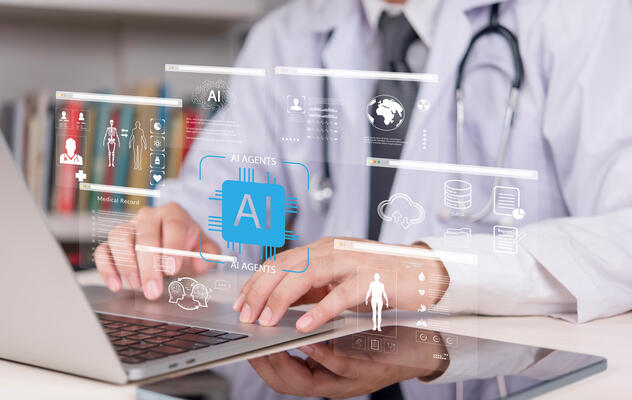
 Engineering the ICU of the future
For nearly 20 years, the Acute Care Informatics Laboratory has been pioneering real-time clinical intelligence that integrates AI, multimodal data and human-centered design to transform ICU data into actionable bedside insights that reduce preventable harm and improve outcomes for people who are critically ill.
Overview
The Acute Care Informatics Laboratory was among the first in the world to embed real-time electronic surveillance, clinical alerting sniffers and cognitive-support tools directly into intensive care unit (ICU) workflows, leveraging Mayo Clinic's advanced electronic infrastructure developed in the 1990s.
The lab is led by principal investigators Vitaly Herasevich, M.D., Ph.D., and Brian W. Pickering, M.B., B.Ch., who have extensive experience in acute and critical care medicine and intelligent hospital systems.
Our mission is to eliminate preventable harm to patients in acute and critical care by building deployable, governable and continuously learning intelligence systems.
Modern hospitals generate overwhelming volumes of physiological, laboratory, imaging, device and documentation data. Yet clinicians rely on a small subset of that data when making high-stakes decisions about patient care. Information overload, fragmented displays, delayed recognition, inconsistent escalation and limited cross-unit situational awareness remain persistent risks in acute care settings.
Our goal is to close this gap by transforming raw clinical data into actionable bedside intelligence. Without this translational focus, digital innovation risks becoming noise rather than signal. Our laboratory was built specifically to ensure that advanced analytics and emerging technologies produce measurable improvements in patient care.
Special areas of research interest
Our lab focuses on the design, validation, deployment and evaluation of intelligent systems for acute and critical care.
We have six main areas of research interest:
1. Real-time clinical surveillance and early detection
Building next-generation electronic sniffers and predictive systems. These are surveillance tools that identify life-threatening conditions such as sepsis, respiratory failure, acute kidney injury and ventilator-related complications before clinical deterioration becomes irreversible. Sniffers provide an early warning system by constantly scanning, or sniffing out, health data that indicate a worsening condition before it's readily apparent to healthcare professionals.
2. Ambient intelligence in the ICU
Viewing the ICU as a complex adaptive system, we develop context-aware systems that support rather than disrupt clinical cognition.
3. Advanced clinical decision support
We're integrating physiological waveforms, device data, laboratory values and clinical documentation into unified bedside-facing intelligence platforms.
4. Evaluation and implementation
We develop methods to ensure optimal real-time system performance, usability, workflow integration and measurable impact on patient outcomes.
5. Clinical data infrastructure and translational platforms
Our lab is a leader in the development of near-real-time ICU data environments that are capable of supporting research, quality improvement and bedside clinical applications. These environments include the Ambient Warning and Response Evaluation (AWARE) system, Acute Care Multi-Patient (AMP) Viewer system and Clinical Events Detection and Response (CEDAR). These infrastructures enable rapid bench-to-bedside cycles and large-scale validation studies.
6. Creating and studying novel technologies for 2030 and beyond
Our current research priorities include integration of:
- Computer vision for patient monitoring and workflow assessment.
- Sensor-derived and high-frequency physiological data streams.
- Clinical reasoning support enabled by large language models (LLMs) and visual language models (VLMs).
- Real-time risk stratification.
- Intelligent reporting systems for quality oversight and operational performance.
We work to embed these technologies directly into ICU and perioperative workflows rather than evaluate them solely in experimental environments.
Research goals
Our overall goals include transitioning from alert-based systems to predictive and prescriptive intelligence that anticipates deterioration of patient medical status and recommends evidence-informed actions. We are working toward embedding artificial intelligence (AI) safely into clinical workflows, with an emphasis on transparency, validation and clinician trust by reducing cognitive load and preventable errors through advanced electronic health record visualization and task-oriented information modeling.
Our work emphasizes rigorous validation, pragmatic clinical trials, usability science and measurable outcome improvement.
Significance to patient care
Our lab has led the evolution of critical care informatics. Our innovations have transformed acute care delivery at Mayo Clinic and beyond. Early pioneering work in automated electronic alerting demonstrated that real-time detection of life-threatening conditions is both feasible and clinically impactful.
Building on this foundation and the integrated AWARE-AMP-CEDAR ecosystem, we're investigating:
- Electronic surveillance sniffers for real-time detection of life-threatening syndromes.
- AWARE: Clinician-designed ICU cognitive viewer to reduce information overload.
- AMP: Population-level situational awareness platform for team-based prioritization.
- CEDAR: Scalable predictive surveillance and standardized escalation workflows across hospital units.
- Next-generation AI systems integrating multimodal sensing, computer vision and large language models in the control tower model of operation.
Together, these systems link detection, cognition and coordinated responses, creating a continuous learning system for acute care.
By delivering relevant information at the point of care, our systems aim to:
- Improve survival of sepsis and respiratory failure.
- Reduce complications, such as ventilator-associated events.
- Shorten ICU length of stay.
- Enhance efficiency of multidisciplinary teams.
- Reduce costs associated with preventable deterioration.
Most importantly, our work seeks to ensure that no critical signal is missed and no patient's condition deteriorates unnoticed in a data-rich but information-poor environment.
With Mayo Clinic's culture of innovation and access to high-acuity clinical environments, our lab uniquely bridges engineering, applied clinical informatics, cognitive science and frontline critical care medicine.
After two decades of pioneering critical care informatics, we are now entering a new phase by integrating artificial intelligence, multimodal sensing and ambient intelligence to redefine what is possible in the ICU of the future.
About the principal investigators
Dr. Herasevich is an anesthesiologist at Mayo Clinic in Rochester, Minnesota. He's also a professor of anesthesiology and a professor of medicine at Mayo Clinic College of Medicine and Science. Dr. Herasevich has been involved in medical informatics for more than 25 years, with a specific concentration on applied clinical informatics in critical care and the science of healthcare delivery. Dr. Herasevich also is a principal investigator, co-investigator and informatics expert for past and ongoing federally funded and industry-funded projects totaling more than $115 million in research support.
Dr. Pickering is an anesthesiologist at Mayo Clinic in Rochester, Minnesota. He's also a professor of anesthesiology at Mayo Clinic College of Medicine and Science. Dr. Pickering's work focuses on improving how hospitals use data to care for patients who are critically ill. Dr. Pickering has helped design and implement AWARE, AMP and CEDAR and other clinical intelligence platforms that organize complex medical information in ways that match how clinicians think and make decisions. A central theme of his work is building new tools and rigorously testing them in real clinical environments to ensure they improve team coordination, patient safety and timeliness of care. Dr. Pickering's current efforts aim to shape the next generation of intelligent hospital systems by integrating advanced analytics, real-time data and responsible oversight into everyday clinical practice.